
Field trip day today – our class went to watch a trial at the court in Utrecht. Outside the court building is this, um, interesting sculpture (picture from the court website):
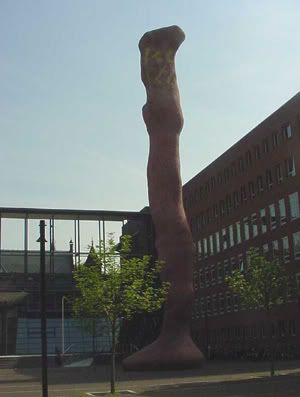
It’s designed by a British sculptor, Nicholas Pope, and is called “Between Good and Evil, the Justice Column”. The information from the site translates as “The pompous concrete pillar which Pope designed for Vrouwe Justitia Square is a striking landmark for the area. Pope’s work is abstract but there are organic forms to represent the different functions of the court. The foot of the column represents the facts, personal stories, the emotions, in short, the human side of the case. At the top of the column, the more abstract side of the case represented, the weighing of the facts to reach a good decision. Humanity is to Pope’s view the purpose of justice. If you walk around the sculpture you can read the words “Lady Justice”.” I know I’m a philistine, but I don’t really see it – to me it just looks like an ugly red bulgy column.
Anyway, the actual business of the court was much more interesting and very Dutch. We watched a case about an man who had tried to pass a truck on a residential street, over a speed bump, and then lost control and went up on the sidewalk and hit a pedestrian and broke several of her bones. It was considered a bit of a complicated case because there was also the question of whether he should have been driving since he’d taken medication. This meant that it was a three judge case – simple cases are heard by one judge. Really complicated cases can have more judges. There are no juries.
After a tour of the court building, we entered the courtroom. In the front of the room is a table with space for the three judges in the middle and a computer to the audience’s right – this is for the court reporter, often a trainee judge. To our left was a space, slanted to the diagonal and coming towards us, for a representative from the “Public Ministry“, the prosecutor for the case. In front of and facing them is a table for the defendant and his lawyer.
The proceedings begin when the prosecutor, judges and reporter come in, all in robes like the British/Canadian robes (the Dutch word is toga!). People rise for their entrance. But after that, the proceedings get a lot more informal. The middle judge is the lead judge and she (in this case two of the judges, the prosecutor and the lawyer were female) begins by asking the defendant, in a neutral and almost sympathetic manner, to tell them what happened, in his own words, reminding him that he doesn’t have to answer the questions. After he’s done, the judge asks him about discrepancies between the witness testimony and police reports (all contained in a nice little file possessed by all the parties) and his story, along the lines of “But the one witness said you had to have been going at least 50 kmh and you say you were going no more than the speed limit of 30,” and giving him the chance to explain or deny what the witness and police reports said. The witnesses weren’t present and I didn’t see a witness stand. In this case, they talked about what happened, the medication he was on, whether he was warned that it wasn’t safe to drive with the medication (I was surprised that neither side had looked up the side-effects) and his medical health after the accident. They also mentioned what happened to the victim, the long-term impact on her health, and summarized the witness statements and the police accident scene team findings and the police statements.
After her questions, the lead judge asks the others if they have any questions. After the judges’ questions, the lawyer is allowed to ask her client questions to clarify anything or to bring forward other information. Everyone gets a last chance to question him. Then the prosecutor gives her opinion of his guilt according to the law and makes a sentencing recommendation. The lawyer gets a chance to argue against this, trying for a different (lesser) charge and a lower sentence (at least in this case). Then the prosecutor again, and the lawyer again. The victim also has a chance to say something at some point in the process but here she chose not to. After all that, the judges say, “OK thanks everyone, we’ll take it all into consideration and let you know in two weeks”.
It surprised me how unconfrontational and informal it was and how it seemed all the parties were trying to work together to apply justice – of course the driver wanted to minimize his fault, but even he seemed calm and rational in the discussion, and he talked so much. We get so used to the American system we’ve all seen on TV both in dramas and in cases like the OJ Simpson thing that it comes as a surprise to see something so different. I haven’t been to a Canadian court (other than traffic court) or watched Canadian court dramas (are there any?) but I think it’s pretty different from that as well. It seemed pretty timely too – the accident happened just over a year ago.
Anyway, I’m glad we had the chance to do that and I certainly hope I’ll never have to experience this first hand, but it really was interesting to see.